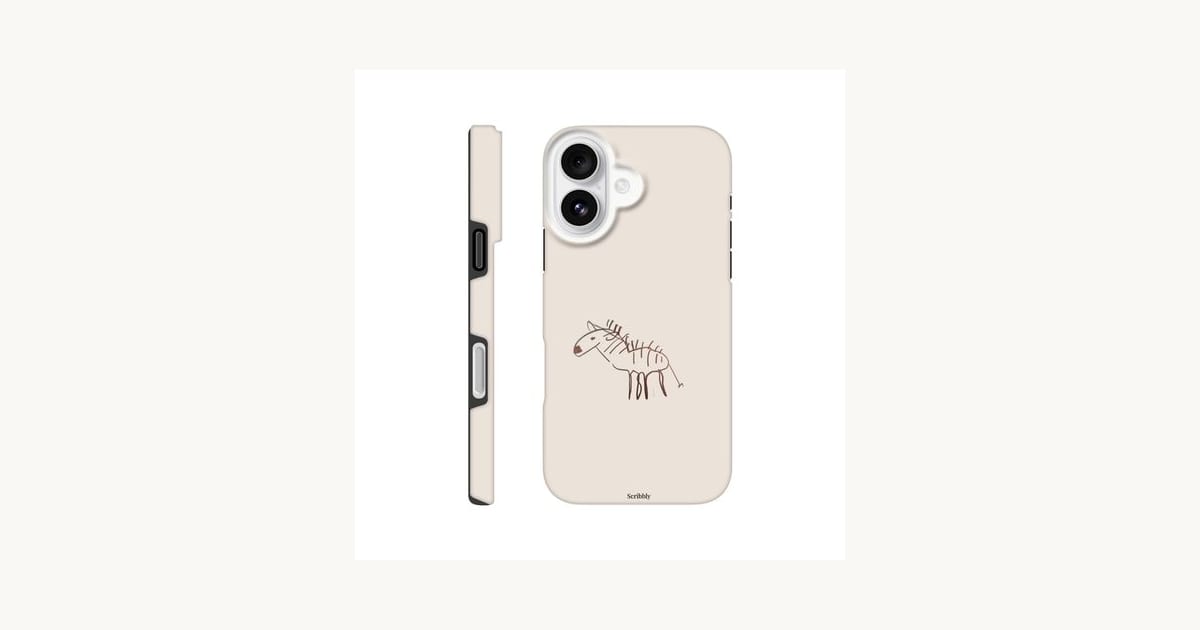
A while ago an app offered to turn one of my son’s drawings into a “professional cartoon version.” I let it. Out came a slick, symmetrical, studio-lit character with clean outlines and a gradient sky.
It was technically better in every measurable way. And it was worthless.
Because the whole point of the drawing was gone. My four-year-old had drawn a cat with one ear twice the size of the other, a tail coming out of its head, and a mouth that took up half its face. The AI had quietly fixed all of that. It gave the cat two matching ears and put the tail where a tail goes. What it removed was the only thing worth keeping: the evidence of exactly how a four-year-old sees a cat.
The mistakes are the memory
You are not saving a picture of a cat. You already have a thousand pictures of cats. You are saving proof of who your child was for a few months in 2026. The specific, unrepeatable way their hand and their brain worked before they learned that ears should match.
Next year the cat will have two ears. The year after, it might have whiskers and a proper tail. That progression is the record. Each drawing is a timestamp. An AI that “improves” the drawing deletes the timestamp and hands you a generic cartoon that could have come from anyone, anywhere, any year.
There is a reason nobody frames the perfect one. Parents keep the seven-legged sun and the family portrait where everyone has triangle heads and the dog is bigger than the house. Those aren’t flaws in the drawing. They are the drawing.
Enhancing is not the same as generating
I want to be fair, because there’s a real distinction here and it’s easy to blur.
Cleaning something up is not the same as replacing it.
When I photograph a drawing, there’s a kitchen table in the shot. Crumbs. A stray Duplo brick. Half a felt-tip lid. Removing that background so you’re left with just the drawing on a clean field, that’s fine. The drawing is untouched. It’s still every wobbly line your kid actually made. You’ve just taken away the mess around it.
That’s the line I care about: you can remove what’s around the art, but you don’t touch the art.
Redrawing the cat with an AI crosses that line. Now it isn’t your kid’s cat anymore. It’s a machine’s idea of a cat, loosely inspired by your kid. Smoothing the paper, cropping the table, adjusting the lighting: all fine, because the marks are still theirs. Regenerating the marks themselves: not fine, because the marks were the whole thing.
This is the entire philosophy behind how I built Scribbly. It removes the background, the table, the crumbs, the lid, and it stops there. It never redraws, never “beautifies,” never generates. What you keep is exactly what your child made, minus the kitchen table. That’s the feature and also the deliberate limit.
What “preserving” actually means
There’s a strange assumption baked into the AI-cartoon apps: that the raw drawing is a rough draft, and the polished version is the finished product. That the child’s work needs a professional pass before it’s worth saving.
I think that’s exactly backwards. The child’s work is the finished product. It’s finished the moment they hand it to you and say “look.” Anything you do after that should serve the goal of keeping it, not improving it. Because “improving” a child’s drawing is a category error, like autotuning a toddler saying “I love you.”
So when you’re choosing how to save your kid’s art, the question isn’t “which app makes it look best.” It’s “which app gives me back the actual thing, in twenty years, still recognizable as theirs.” A folder of AI cartoons fails that test. A clean photo of the real drawing passes it.
Keep the paper too, if you can
None of this is an argument against the paper. If you have the space and the discipline, keep a few real originals in a box. Paper is the real thing, and there’s nothing like holding it.
But paper doesn’t scale, and paper doesn’t survive. A stack survives two house moves and one damp basement, tops. The tempera flakes, the felt-tip fades, the box gets rained on in the garage. A good photo of the real drawing survives all of it, and you can hold a hundred of them in a book on a shelf instead of three shoeboxes in the cellar.
So keep the best originals. Photograph the rest, the actual drawing, not a cartoon of it. In a year you’ll have a record of a specific small person at a specific age, ears mismatched, tail on the head, exactly as they were.
The AI version would have been prettier. It also would have been a stranger.