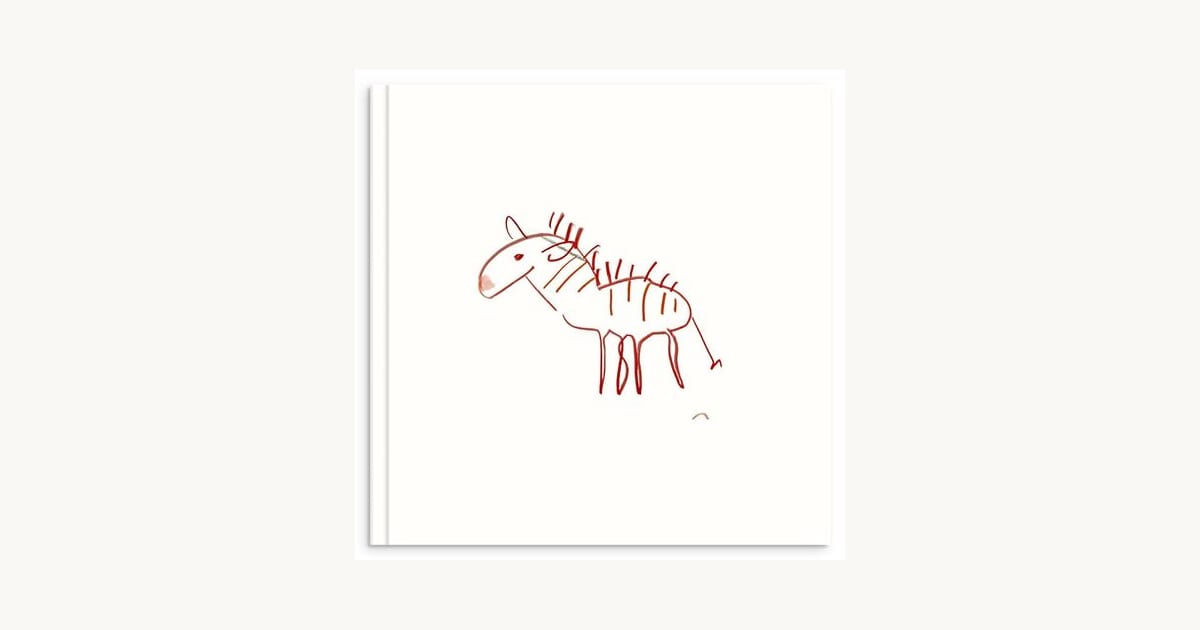
Father’s Day falls at different times depending on where you live. Switzerland: June 7. Austria: June 14. US, UK, France: June 21.
For most markets, there are still a few weeks. A printed book of your kids’ drawings is still deliverable before the date, if you start this week.
This is the practical version of that idea. Not the why (enough posts already cover why a book of kids’ drawings makes a good gift). This is the how: selection, photography, ordering, and the delivery windows you actually need to know.
What you need to get started
Not much. Six to ten of your kid’s drawings, your phone, and about 45 minutes spread across a couple of evenings.
The hardest part is usually the selection. Kids produce a lot. A child at nursery or primary school makes around a hundred pieces per year. Not everything belongs in a book.
The ones worth including are the pieces where the child made all the decisions: the subject, the colors, the composition. The purple giraffe. The family portrait where everyone is the same height. The inexplicable drawing of a boat.
Leave the craft projects out. Colored worksheets, pre-drawn outlines they filled in, anything where an adult handed them a template. What you want is their actual creative work, however strange.
Let the child help select. Kids have strong opinions about their own work and they’re almost always right about which pieces are the good ones.
How to photograph the drawings
Flat on a white surface, window light from one side, phone held directly overhead. No flash. If there’s a placemat or a coffee ring under the drawing, put a sheet of white paper underneath it first.
The photo that doesn’t work: the quick shot taken on the kitchen table at an angle with three other things in frame. That’s the photo most parents have, and it’s not usable as-is.
The photo that works: window light, clean surface, phone parallel to the paper. Thirty seconds per drawing once you have the setup.
Background removal makes a real difference here. A drawing photographed against a kitchen table still looks like a kitchen table photo. The same drawing on a clean white background looks like art, which is what it is.
Scribbly handles background removal automatically: you photograph the drawing, upload it, and the app strips out whatever was behind it. What’s left is the artwork on white, ready to arrange into a book. The app is free on iOS and on the web.
Ordering timelines for the upcoming Father’s Days
Standard printing and shipping from European printers runs 3 to 5 business days, end to end.
Switzerland (Father’s Day June 7): Order by Tuesday May 26 or Wednesday May 27 at the latest. Printers can run slower before popular gift occasions, so earlier is better.
Austria (Father’s Day June 14): Order by June 6 for standard shipping.
US, UK (Father’s Day June 21): Order by June 13 for standard delivery. June 14 or 15 is possible but cutting it close.
France (Fête des pères June 21): Order by June 13.
These are rough guidelines, not guarantees. Always check the estimated delivery date at checkout before confirming. Printers vary, and regional logistics add unpredictability.
If you’re ordering for Fête des Mères in France (May 31), order today or tomorrow. That’s the realistic window for standard delivery.
What to do if the shipping window is already tight
Give the order confirmation instead. “I’ve ordered something for you, it arrives next week” is a full sentence. It says you thought about it, chose something personal, and had it made. The physical object arriving a few days later lands the same way.
Or, the slideshow. Go through your camera roll, find every drawing photo you’ve taken in the past year, put them in chronological order, and show them on the morning of the occasion. An unbroken record of a year’s worth of a kid’s art, seen all at once, is genuinely moving for most parents. It’s not a backup plan. It’s a different kind of gift that costs nothing but the attention you’ve already been paying.
When it’s worth doing at all
Kids make art freely during a specific window, roughly ages 2 to 9 for most children. After that, they start comparing their work to others, get frustrated with the gap between what they imagine and what they can actually draw, and many stop. The drawings they make now, with impossible perspectives and too many fingers and heads that take up two-thirds of the page, will not come again.
A printed book captures something that would otherwise stay in a drawer until the next move. It turns a year of drawings into an object that gets put on a shelf and pulled out. My older son has one. He flips through it and says things like “I was really into purple.” He has never once opened the box where the originals live.
The occasion is the excuse. The book is the thing that stays.
For guidance on which drawings are worth keeping at each age, Toddler Art vs School-Age Art covers what changes and when. For the full photography technique, How to Photograph Kids’ Art walks through it step by step.