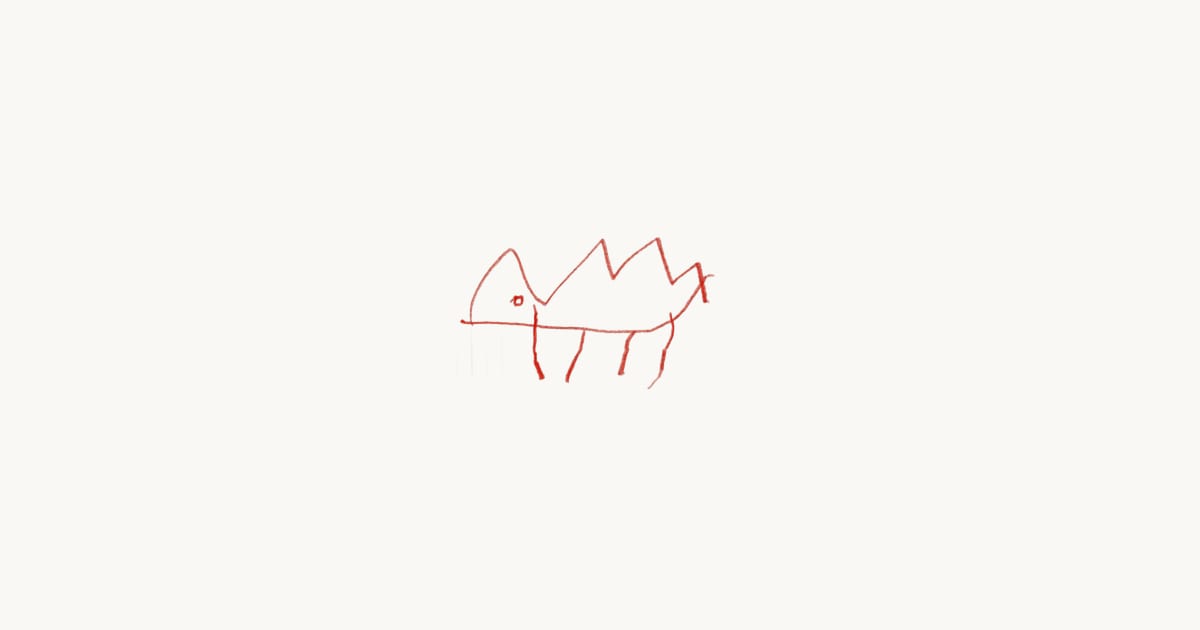
My kid drew a family portrait where I’m the same size as the cat. The cat is not small. I am, apparently, not large.
He was four at the time. Now he’s six, and he draws me taller than the cat. Progress, I suppose. But the four-year-old version is the one I framed.
Different ages produce wildly different art. This is obvious once you see it, but most parents don’t notice until the old style is gone. And the instinct for what to keep tends to be exactly backwards: too much at the start, not enough later.
Age 1-2: The scribble years
These aren’t drawings. They’re motor experiments. Your toddler is discovering that a hand movement creates a mark. There’s no horse, no house, no family. It’s cause and effect with a crayon.
My younger son’s earliest drawings look like seismograph readouts. Horizontal strokes, mostly, because that’s the natural motion of a toddler’s arm. Then one day a circle appeared. It wasn’t anything. But it was deliberate.
What to keep: Two or three per year. The first controlled mark. The first circle. The first time they used more than one color on purpose. Date them.
What to let go: The other 50 identical scribbles. They served their purpose. The purpose was arm practice.
Age 3-4: The golden age of weird art
This is it. This is the stage you’ll miss most, and you won’t know it until it’s over.
Circle people appear. A head with legs coming directly out the bottom. Eyes, mouth, legs. No torso, sometimes no arms. It’s not wrong. It’s a priority list: face first, movement second, everything else optional.
My older son drew people like this for about a year. Then suddenly the people had bodies. The circle-people era was over. I have maybe six of them saved. I wish I had ten.
At this age, houses are bigger than trees. Hands have three fingers. The sky is a blue stripe at the top of the page, not connected to the ground. Family members are sized by emotional importance, not height. The dog is enormous. Dad is small. I’m told this is normal.
The other thing about this stage: the stories. A three-year-old will narrate their drawing as they make it, changing the plot halfway through. “This is our house. And this is a dragon. The dragon lives in the house now. We moved.”
What to keep: More than you think. This is the stage to over-keep. Ten to fifteen originals per year is not too many. Circle people, floating houses, weird family portraits, anything with a story attached.
What to digitize: Everything else worth a second look. The daily Kita paintings, the finger-paint abstracts, the collages.
Write the caption. Every single time. “This is our family. The big one is the dog.” That line on the back of the drawing is worth more than the drawing itself in ten years.
Age 5-8: Transition to self-criticism
The baseline appears. People stand on ground. The sky comes down to meet the horizon. Proportions start making sense. This is when drawings start looking “correct,” which makes them less strange and less revealing. A four-year-old draws what matters. A six-year-old draws what they see.
Then, around seven or eight, kids develop the ability to compare their work to what they intended. A five-year-old draws a horse that looks like a dog and calls it a horse. An eight-year-old draws the same thing, sees the gap, and crumples it up.
Many kids slow down here. Some stop altogether. The ones who keep drawing start caring about getting it right. The unselfconscious stage is ending.
This is also when parents tend to stop keeping art. The fridge clears out. The pile on the counter shrinks. It feels like there’s less to save. That instinct is wrong. An eight-year-old who still draws despite the self-doubt is making something worth keeping.
What to keep: Anything they put real effort into. Anything they’re proud of. Anything that shows what they’re thinking about: superheroes, animals, detailed maps of imaginary worlds.
Age 9 and beyond: Intention replaces instinct
If they’re still drawing at nine, it’s becoming a hobby. The art is deliberate. They have preferences, styles, maybe sketchbooks. This is a different kind of preservation: less about capturing a developmental stage, more about respecting something they’ve chosen to do.
If they’ve stopped drawing, the window has closed. What you kept from earlier years is what you have.
The common mistake
Here’s what I see, in my own behavior and in every parent I’ve talked to: too much keeping at age 3, not enough at age 7.
At three, everything feels precious. The first person, the first house, the first sun in the corner. You keep it all. The box fills up.
By seven, it’s just another drawing. They make them faster, they look more normal, and somehow they seem less worth saving.
But the seven-year-old who draws a detailed map of their school playground is telling you exactly as much about their world as the three-year-old who drew a floating house. The signal is the same. The volume is lower.
A sorting system helps. So does a weekly habit. But the first step is knowing that your keeping instinct will fade before the art does.
A quick reference
| Age | Keep (physical) | Digitize | Let go |
|---|---|---|---|
| 1-2 | 2-3 milestone pieces per year | Any controlled marks | Most of it |
| 3-4 | 10-15 per year (golden age) | Everything interesting | Daily duplicates |
| 5-6 | 5-10 story pieces per year | Transition examples | Quick sketches |
| 7-8 | Anything with real effort | Detailed work | Nothing they cared about |
| 9+ | What they’re proud of | Sketchbook pages | Their call, not yours |
And at every age: date it, caption it, store it properly.