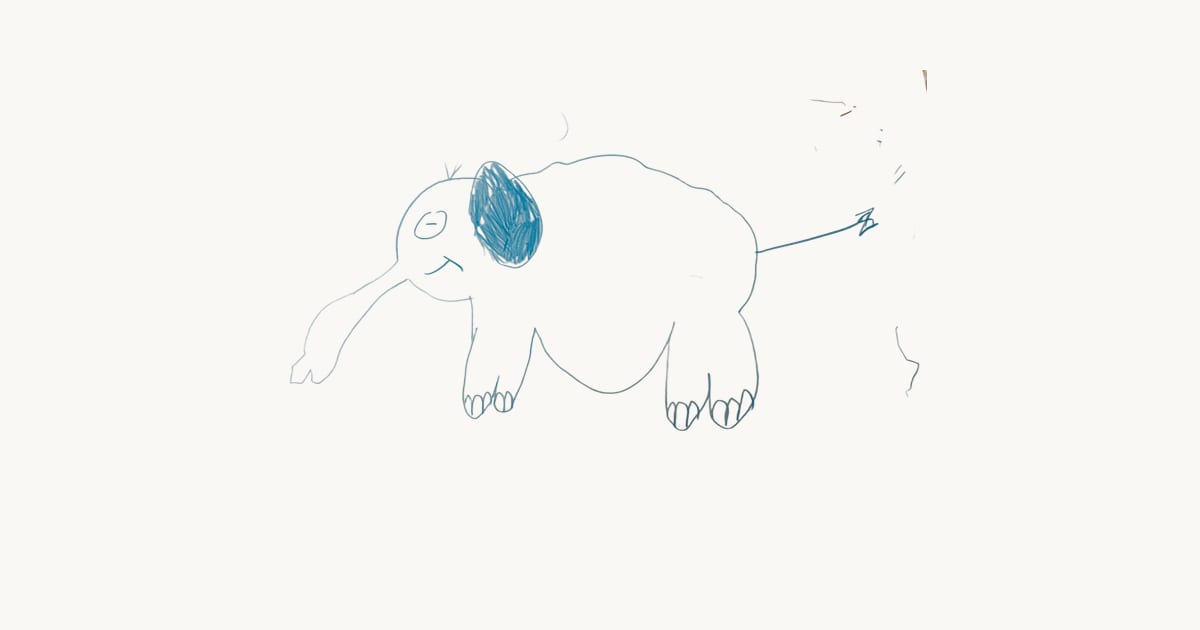
My older son used to draw people as circles with legs coming straight out the bottom. No torso. No neck. Eyes, mouth, legs. Done.
He’s six now, and the people in his drawings have bodies. Arms come out of shoulders. Feet point the right direction. The drawings are objectively better. They’re also less interesting.
That shift happened without me noticing. I only caught it when I flipped through the old ones and realized: that version of how he sees people is gone. He can’t draw like that anymore, even if he tried.
When do kids stop drawing
Children’s art follows a surprisingly predictable path. Researchers have been mapping it since the 1920s, and the stages hold up across cultures, languages, and continents.
Scribbling (roughly ages 2-3). Random marks at first, then controlled ones. They’re not drawing things. They’re discovering that a hand movement creates a line. It’s cause and effect, not representation.
Pre-schematic (roughly ages 4-5). This is the golden age. Circle people. Floating houses. The sun in every corner. A family portrait where Dad is the same size as the cat. (I’m choosing not to read into it.) They draw what matters to them, sized by emotional importance, not physics.
Schematic (roughly ages 6-7). A baseline appears. The sky meets the ground. People stand on things. Proportions start to make sense. They’ve learned to see what’s “right” and their drawings begin to show it.
The drop-off (roughly ages 8-9). Many kids stop drawing altogether. Not all. But many.
These stages aren’t rigid. Some kids move faster, some slower. A three-year-old might draw recognizable people. An eight-year-old might still draw floating houses. But the general arc is consistent enough that art therapists and developmental psychologists use it as a diagnostic tool.
The window that matters most, that pre-schematic stage from about 4 to 6, is also the shortest.
Why they stop
It’s not one thing. It’s several things converging at once.
Self-criticism arrives. Around age 7 or 8, kids develop the ability to compare their work to what they intended. A five-year-old draws a horse that looks like a dog and says, “That’s my horse.” An eight-year-old draws a horse that looks like a dog, sees the gap between intent and result, and puts the pencil down.
Peers become mirrors. “That doesn’t look like a real car.” One comment from a classmate can end a drawing habit. Kids at this age are learning to see themselves through other people’s eyes, and that includes their art.
School shifts the frame. In Kita and early primary, art is open-ended. Paint what you feel. Draw your family. By third or fourth grade, art class starts to have right answers. Perspective. Shading. Technique. The kids who aren’t “good at drawing” self-select out.
Screens fill the gaps. This isn’t a moral judgment. But the moments kids used to fill with drawing, waiting rooms, car rides, Sunday mornings, now get filled with tablets. Drawing requires tolerating boredom long enough to start. A screen removes the boredom before the pencil moves.
None of these are anyone’s fault. They’re just how development works. But they mean the window closes, and it closes faster than you expect.
What actually gets lost
It’s not artistic talent. Most of those kids were never going to become artists, and that’s fine. What gets lost is the record.
A four-year-old’s drawing of their family tells you who matters in their world. Who’s big, who’s small, who’s standing close together. It tells you this without them knowing they’re telling you. The drawing is honest in a way that answers to “How was your day?” will never be.
A five-year-old’s drawing of their house shows you what home means to them. The door is always the biggest thing. The chimney has smoke, even if you have no chimney. There are flowers, even in February.
My younger son drew a picture of our apartment recently. He included the balcony, the plants, and a large yellow blob that I eventually identified as our pasta pot. The pasta pot made the cut. The bathroom didn’t. That tells me something, and it won’t tell me the same thing in two years because he’ll have moved on to drawing things that look “correct.”
This is what goes away. Not the skill. The unselfconsciousness.
The caption on the back
Here’s what I’ve learned after spending two years building an app around kids’ art: the drawing itself is only half the artifact.
The other half is what the child said about it. “This is Mama at work. She’s on the phone. The dog is sad because she left.” That narration turns a crayon scribble into a time capsule.
Write it on the back. Date it. Note the age. In 20 years, the drawing will make you feel something, but the caption will make you cry.
I say this not as a product pitch but as a parent who nearly lost a year of his kid’s drawings to a water leak in a cardboard box. You don’t know what you have until it’s a soggy mess on a basement floor.
What to do about it
You can’t make a kid keep drawing. And pushing too hard backfires. But you can make sure the drawings that exist get preserved while they exist.
Capture now. Not next weekend. Not when you have time. The pile on the kitchen counter is the archive. Photograph it, sort it, do something with it before it becomes the bottom layer of next month’s pile.
Write the context. The child’s name, age, date, and what they said about it. Five seconds of effort that pays off in two decades.
Don’t edit. Don’t ask them to add a background. Don’t suggest the sky should be blue. The “wrong” parts are the point.
Keep a few originals. Digital is smart and practical. But the texture of a crayon on sugar paper, the thickness of the paint where they pressed hard, that’s physical. Keep ten or fifteen per year in a portfolio box.
Accept the window. The scribble phase ends. The circle-people phase ends. The weird floating houses end. You can’t extend the window, but you can make sure you have something from it when it’s gone.
My older son’s drawings are getting technically better every month. Baseline, proportions, detail. He’ll probably keep drawing for a while.
But the version of people that were just circles with legs sticking out? That kid is already gone. The drawings are the only proof he was ever there.